drawing deeply from the well

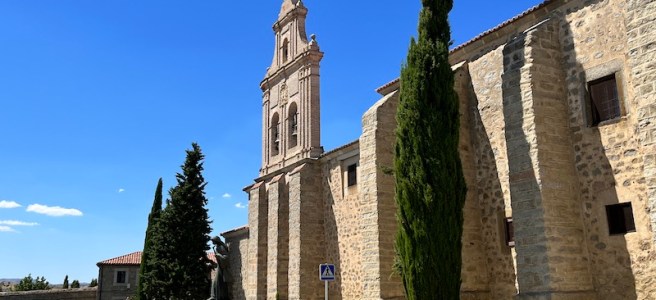
Image of el monasterio de la Encarnación in Ávila, España by Julie Vieira (August 17, 2023)

Memorial of Saint Teresa of Jesus, virgin and doctor of the church
Romans 8:14-17, 26-27
Psalm 33:2-3, 10-11, 18-19
John 4:5-15

Dear Sisters, Brothers, and Siblings — Happy Feast Day.

In August, I had the great delight and honor to visit la ciudad de Ávila in España. Each day I was there, I visited my favorite place, el monasterio de la Encarnación. I’d walk from the old town of Ávila down the fortified hill, and a few blocks through a neighborhood toward the monastery. Once I reached the street, Calle de la Encarnación, I could see a couple blocks away the magnificent statue of Teresa – you know the one, where she stands tall, walking staff in hand.

I would enter el patio de la Encarnación, an outdoor terrace just within the monastery walls. From where I sat on stone bench, I could see the very door through which Teresa entered the Carmelite Order in 1535. Each day, I sat there and wrote, eager to encounter Teresa and the God who so enraptured her heart. I waited and listened. I listened and waited. And then I waited some more. I figured, what better place than for divine inspiration?! I waited and listened. Nothing.

Finally, I gave up. I figured that if Teresa was going to be silent, so would I. I put away my notebook and pencil and walked out. But I couldn’t leave. So I started to wander around outside, down the street past the main entrance of the monastery. I followed the outer walls of Encarnacion, curious about the space that Encarnación occupied. It was not a short walk. The property was much more extensive than I ever imagined. I was getting tired, and the heat of the day was relieved only by the coolness radiating from the stones of the massive walls.

After what seemed like an impossible number of left-hand turns, I started to recognize things again, and up ahead I could see Calle de la Encarnación again. As I neared the crossroads, ready to take my final left to get back to the main entrance, I saw a sign. That’s right, a sign. A STOP sign to be exact. Below it were the words, “Convento de San José (Las Madres) Primero Fundación de Santa Teresa de Jesús”. Next to the words was an arrow. The arrow, slight though it was, pointed in the opposite direction of Encarnación.

It is then that I remembered. Teresa left. She left Encarnación. She left and she set out. She left what had been her home and her local community of many years. Familiar walls, familiar faces, familiar routine, familiar spaces to encounter God. She left. The statue that we love so much and that is replete with emotion and intensity and meaning. With walking staff in hand, Teresa is setting out to re-found the Carmelite order. Her back is to Encarnación, and her face is set like flint, heading towards San José, the first convent of the Carmelite reform.

The woman from today’s gospel is no different. She encountered Jesus not in a monastery but in a familiar place — Jacob’s well. The well dated back nearly 2 millennia to the time of Jacob in the land of Samaria, in the town of Sychar, “near the plot of land that Jacob had given to his son Joseph” (John 4:5). It was familiar not only to the woman but to her ancestors who day after day, year after year, came to draw water.

Jesus presented the woman with a crossroads. He asked her to let go of the familiar and to draw water not from this spring that had served her and her people for years, but to draw living water, that is, water flowing from God’s endless spring of Wisdom. It is the Wisdom we hear about in our first reading, “I loved Her more than health and beauty; I preferred Her to the light of day, for Her countenance shone unceasingly.” (Wisdom 7:10)

The woman couldn’t believe what she was hearing from Jesus. “Who do you think you are?” she says to Jesus. (John 4:12). Perhaps she even wondered to herself, “Who do I think I am to receive this water?” Still, she waited and listened, longing for more.

And then she gets it.

She leaves her water jar behind and sets out. Her faith is being refounded – what it looks like, she’s not sure – but she sets out to live that refounding and share it with others.

Are we not at this same place? Are we not at a crossroads and being invited to leave the familiar and to set out for the new?

Even when the signs are clear, we don’t always know what to do or how to take a next step. When I stood at the crossroads – Encarnación to my left and the refoundation of San Jose on my right – I’m proud to say that I took the road most traveled. I turned left to Encarnación.

You see I love everything that Encarnación stands for. I love the peace and calm I feel. I love the cast-iron handle that I can grasp and pull open just as Teresa did some years ago. But I still had to go. I’d like to say that I set my face like flint and headed for San Jose, but instead I went into town, and sat in la plaza, surrounded by the night life of Ávila. I resigned myself to peanuts and beer.

It is then that Teresa came and sat down beside me. Her presence is as unmistakable to me as our communion of IHM saints “dwelling now in light yet ever near”.

“Go,” she said. From Encarnación to San Jose. Go. From the walls to the city, to the fields to the rock-strewn paths and the sun-scorched plains. Go.”

For Teresa to go, for the woman at the well to go, and for us to go, we must draw richly from the well of living water. We must leave behind the familiar, leave behind even the water jug that has served us so well. What does this look like?

I’m reminded of a few stories I heard over the past few days:

  • the couple in their 60s who overnight find themselves to be parents and grandparents as they adopt a young woman and her child as their own
  • the school board who chooses to welcome with open arms a student who is transgendered
  • the religious sister who places her body literally in the crossfire of warring nations in order to ensure peace and safety for all
  • the middle-aged mechanic who in the midst of anxiety and depression, chooses not to give up on themselves

This is what it looks like to have living water flowing through you – to be open to and to live into God’s invitation to life, even when it seems unfamiliar, absurd, unpopular, or terrifying.

What crossroads are we at today – as individuals, as families and religious congregations, as nations and an earth community? Where are the wells inside of us and around us from which we are called to draw living water?

Wait and listen.

Then go …

… from Encarnación to San Jose. Go. From the walls to the city, to the fields to the rock-strewn paths and the sun-scorched plains. Go.

image credit: julie vieira

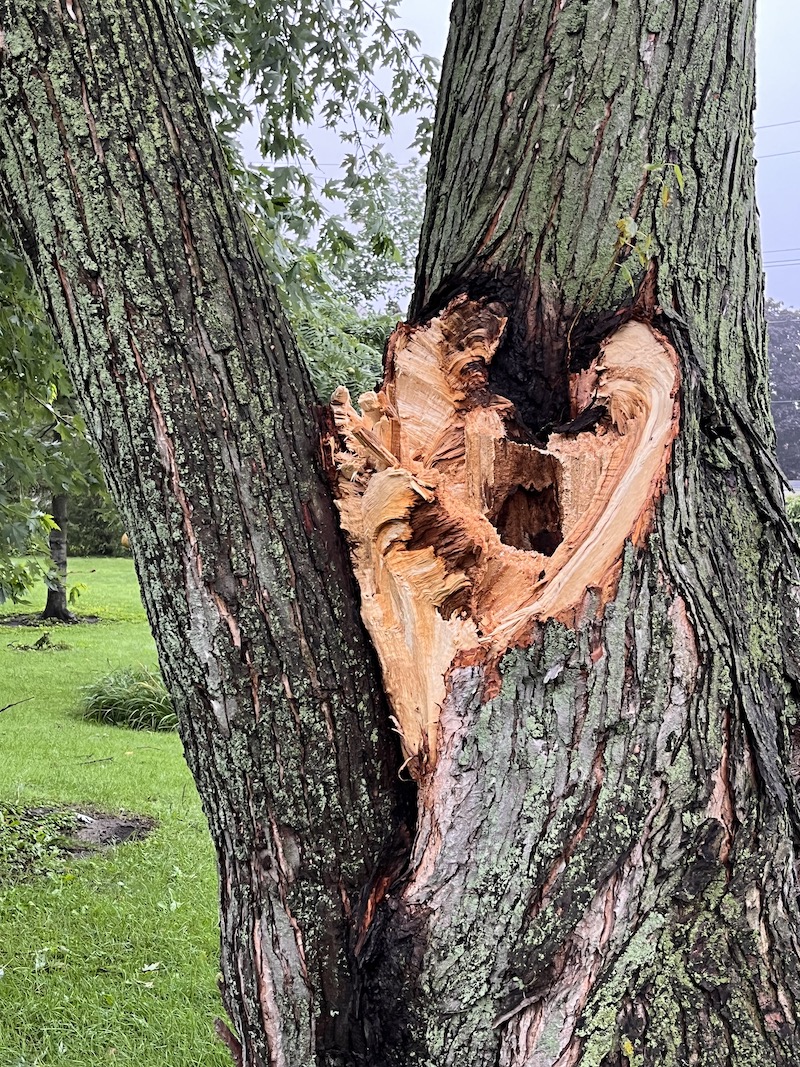
the heart-broken tree

One has to stop doing an ideological frisk of everything, to stop pigeonholing works by their presumed ideology…. A film isn’t an affirmation, an answer to a question, just as art does not refer to something, but is a thing in itself.

Film director Lola Cuevas responding to a question at a press event
From the satirical movie Competencia oficial (2021)

Storms hit southeastern Michigan hard a couple weeks. I had barely stepped off the plane on my return from Spain when the thunder and rain started Wednesday night. Power outages, flooding, and lots of damage. Manageable compared to other disasters in the world, but still a thing to contend with.

It was a one-two punch. Whilst dealing with the damage from Wednesday night’s storm, a second one pounded the area on Thursday night. That second one was a bit too much for some of our older trees to withstand. We woke up Friday morning to find several dear trees on our land fallen to the ground.

I didn’t see them at first. I got a text message early in the morning from a nearby nun saying that her next door neighbors (also nuns) had a tree “branch” come down on their driveway. I was headed in that direction any ways to check on flooding by the river so I figured I’d stop at the house and heft that branch out of the way.

Well, that was no branch. And no amount of hefting would have budged it from its place. It was one of three trunks of a tree in the backyard of the house. It broke in the storm and fell in the narrow space between the house and the garage, with nary a scratch on either. “It was like its final gift to us,” one of the nuns marveled.

I went to the main tree still standing, quietly as if to a bereaved partner. I reached out and let my hands lightly trace the crevices etched in the bark. Though rough and weathered, the bark was also soft, still moist from its tangle with the storms of the past two days.

I listened to the silent creaking of the tree. Yes, silent creaking. The wind was still pushing against the tree, but I heard nothing. The tree was silent. There was just the sound of my expectation, the creaking in my imagination.

In the background, I could hear the nuns murmuring.

about the tree and their longtime companionship with it

about the storm damage and how we might work together on behalf of the local community

about the mystery of life and the lament of death

about what’s for lunch

I stepped back from my face-to-face communion with the tree. And that’s when I saw it. The heart of the tree.

The place where the tree had cracked was heart shaped. I could hardly believe it. “I’m gonna have a mystical moment right here, right now,” I thought. Thousands of spiritual ideas about a broken-hearted tree flooded my imagination. Oh the symbolism! Oh the cosmic oneness! This I can write about! This I can preach on!

I broke my so-called “mystical” train of mind so that I could snap a photo. I was intent on capturing the moment.

And just as quickly as I snapped that photo, I felt sick to my stomach. In my gut ⎻ in las entrañas, as Teresa de Ávila would say ⎻ something was wrong.

My mind quieted, and I saw that moment, just minutes earlier, when I first walked up to the house. One of the nuns was already outside standing by the tree. Her eyes sparkled with both tears and delight as she looked at the fallen tree. There was nothing for either of us to say. The tree was gone. Neither words nor prayers would bring it back.

Fast forward to yesterday. I stood in the kitchen with a coworker, a spray bottle of pine cleaner in one hand, a rag in the other. She told me about her friend who was killed just a few days prior in a car-jacking in our neighborhood. There was nothing for either of us to say. This young man was gone. Neither words nor prayers would bring him back.

There was no “meaning making” to be had. No mystical insight. Just sorrow and anger.

We did the only thing we could do. We started cleaning.

[An event, a happening,] isn’t an affirmation, an answer to a question, just as art does not refer to something, but is a thing in itself.

I am not one to sit restfully in silence and contemplation. It makes me uncomfortable, anxious, and restless. I used to think that that was a lack of virtue on my part, stunted spiritual maturity. But I’m slowly accepting that it is part of my makeup. And I wonder if it is not also a form of contemplation in its own right. [I’m using the word “contemplation” in a more general sense, not the more specific ways that we’d use the word in theology or in studying the works of Teresa].

As I write, I’m reminding of a website that was run by Carmelite nuns called PrayTheNews.com. It strikes me that these women knew what it meant to enter into contemplation that was messy and uncomfortable, that inspired not inner communion but anxiety and restlessness. I wrote about this years ago in an article called “Pray the Newsfeed” for Global Sisters Report though my focus then was different.

And so.

The tree is broken. The heart we see is splintered biomass, not a mystical manifesto.

We do not have to make the splintered whole, the suffering meaningful, the grotesque palatable.

We do not have to invoke God to this broken space. God is already there. This is true mysticism.

Even though my mind is still racing with spiritual thoughts, I think it’s time to take up my contemplative posture of restlessness, discomfort, and anxiety. And to pick up a spray bottle and rag and start cleaning.

A final thought from Lola Cuevas. [I’ll have to remember this next time I am tempted to go all-out manifesto on some experience!]

The fact that you see a manifesto in my film is rather reductionist, to my taste, intellectually lazy.

Film director Lola Cuevas responding to a question at a press event
From the satirical movie Competencia oficial

What is it like for you to read this? Do you too struggle with these heart-broken moments? How do you approach things?

image credit: julie vieira

on humility

I do not know whether I have put this clearly; self-knowledge is of such consequence that I would not have you careless of it, though you may be lifted to heaven in prayer, because while on earth nothing is more needful than humility. Therefore, I repeat, not only a good way, but the best of all ways, is to endeavor to enter first by the room where humility is practiced, which is far better than at once rushing on to the others.

Teresa de Ávila, Interior Castle 1.2.10

I thought I had a good grasp on what humility means. I had understood humility to mean that icky feely when one is embarrassed or ashamed of something that they’ve done. Mortified.

“It’s an opportunity to learn the virtue of humility”, they say. No wonder I’ve always been so resistant to humility.

As it happens, this is not humility at all. It’s humiliation. It’s an understandable misunderstanding. Humiliation and humility share the same etymology. They come from the Latin word humilis meaning “low”.

Humiliation is a sucker punch to the gut. It hurts. It can affect one’s self identity and confidence, and over time, it can can lead to trauma. Humiliation does not make us grow stronger, and it most certainly is not a pathway to the virtue of humility. Don’t ever let anyone tell you different.

Humility is another creature altogether, and I am pleased to make its acquaintance. Teresa de Ávila says that it essential for “while on earth”, and I’m beginning to understand what she means.

I’ve been in Spain now for a couple weeks and also spent some time in Portugal. My castellano – “castilian” is the official language of Spain but there are many languages of Spain including euskara, catalan, and gallego) – is beginner level and my portugués is nearly non-existent. Although english is widely understood throughout the world, it’s not spoken by everyone. I am very conscious of using the local language as a matter of respect and appropriateness. I am a guest and not entitled to others’ deference to my language and the customs of my culture. It is not easy, but I would have it no other way. I’ve had many (MANY) missteps and am grateful for people’s patience. I’ve even had the occasional on-the-spot lesson by generous locals who take the time to help me learn.

I have been realizing that what I really need is to find a space of humility within myself so that I can have more openness to that which is beyond me. A space of humility. Spaciousness. Humility is a kind of pause that recognizes my “me-ness”(self-knowledge) and our “we-ness”. This “we-ness” is about the “more-ness” of any and every experience. I am connected to this people, this patch of earth, this local custom, this typical food, this way of being no matter how much “strange-ness” I or others may feel.

That’s a lot of “-ness” but it’s the best way I can communicate how it feels. “Ness-ness” leaves room for the gracious unknown, the mystery of being, experiencing, and relating. And humility is the doorway to this room, this spaciousness.

It’s a different world when one strives for humility. Living within a different language, culture, and geography for even this short time gives me a concrete and practical example of the humility necessary to be truly open and curious and even surprised. The missteps sting at times, but I am finding my way of being “me” and “we”. I have mastered saying Quisiera un cafe con leche, por favor (“I would like a latte, please”). I am becoming proficient at public transportation by way of metros, buses, tranvías, funiculares, and even a teleférico! These are small things, but they show me a way to enter in, to be part of the larger community and world.

I’m curious to see how humility will continue to unfold in my life – in how I am with myself, in how I perceive things, in relationships, and in pursuit of my passions.

I am also curious to know how you have experienced humility. How have you practiced humility? What does it mean for you?

Image: Photo of three people praying at the
Buddha Tooth Relic Temple, Singapore, by Lily Banse on Unsplash

el camino de Teresa de Ávila

“Do not be frightened, daughters, by the many things you need to consider in order to begin this divine journey which is the royal road to heaven. A great treasure is gained by traveling this road.”

Teresa de Ávila, Way of Perfection 21.1

As I walk along the cobbled streets of Casco Viejo, the old town of Bilbao in northern Spain, I see symbols of el Camino de Santiago everywhere. Bright blue tiles with the iconic scalloped shell are embedded in the road. Travelers enjoying cold cervezas in the plazas, backpacks and walking sticks resting beside them.

In one such plaza, I met Jacob from the United Kingdom. He joined me on a stone bench beside a fountain, each of us enjoying coffee. As we fumbled in our Spanish 101 dialect to greet one another, we recognized English “accents” beneath and quickly switched over. Jacob was traveling the Camino alone. He began his journey in San Sebastian and was now spending a few days in Bilbao. I shared that I was visiting a friend who lives in Bilbao and focusing on my work as a writer. While I would not last long on the walking journey of El Camino de Santiago, I explained, I have great appreciation for the journey and the unnameable desire deep in one’s heart to give oneself to seeking un camino, a way that engages body, mind and spirit and that fully incarnates “journey”. (“Write that down,” Jacob said. “That’s really good.”)

We talked for a bit and then sat in silence drinking our coffee and listening to a street performer deftly wielding her saxophone. When we parted ways, we wished for one another un “buen camino”.

It wasn’t until today that I made the connection between camino and Teresa de Ávila’s book The Way of Perfection which I just began to re-read. Yes, “the way” in the title of her book, but more than that, it is the realization that my longtime friendship with Teresa has been a kind of camino, a way. In her writing, I have discovered images and insights about not just my own spiritual journey but my quirky way of being. This way has taken me along cobblestone roads and unmarked trails deep in the forests of my being. These paths have been forged by reading, praying with, and reflecting on Teresa’s words More significantly, it has also been conversing with Teresa “directly” in our unique language as one does with the saints.

Visiting Spain affords me another dimension to experiencing this way. Ávila is just a train ride away, and Teresa’s foundations are scattered throughout Spain. I am looking forward to visiting Ávila in a couple weeks, returning for the third time since my very first visit in 2011. Being in Ávila is a visceral experience of my way with Teresa. I can feel the way and, like I unwittingly said to Jacob, it is fully engages my body, mind and spirit.

Entonces. So, I can think of no more fitting way to begin writing on this eponymous website than by exploring dimensions of my camino, my way, especially as I walk with Teresa. It is through writing that I best understand the ways that I live and move and have my being in this strange and beautiful, pierced and broken life. Maybe too you will hear echoes of your own way and take time to sit on a stone bench with me and share your story.

They must have a great and very determined determination to persevere until reaching the end, come what may, happen what may, whatever work is involved, whatever criticism arises, whether they arrive or whether they die on the road, or even if they don’t have courage for the trials that are met, or if the whole world collapses.

Teresa de Ávila, Way of Perfection, 21.2

Image Credit: julie vieira

and Joseph wept

Wednesday of the Fourteenth Week in Ordinary Time
Lectionary: 385

Genesis 41:55-57; 42:5-7a, 17-24a
Psalm 33:2-3, 10-11, 18-19
Matthew 10:1-7

I’ve always loved the story of Joseph. I wasn’t in it so much for the technicolored robe as I was for how he was able to survive after being nearly killed by his siblings and then sold into slavery. I was amazed that he was able to make a life for himself and eventually become a person of power and influence. It was poetic genius of the writers of Genesis to note that years later, the brothers would find themselves at the mercy of the very one whom they had rejected.

Even listening again to the story now, I feel great satisfaction in Joseph tossing his brothers into the guardhouse and making them think about what they had done. But what has always perplexed me is that upon hearing the brothers discuss what they had done, Joseph turned and wept.

He wept.

I want Joseph to shout and curse them, to throw tables and chairs. But Joseph just turned from them and wept.

This is neither the first nor the last time that Joseph weeps. In fact, throughout the accounting of his life, he has frequent bouts of weeping.[1] At one point, he weeps so loudly that even the Egyptians in the other room can hear him![2] Some have interpreted this weeping as a psychological characteristic of Joseph. He was a tender soul. Passionate and sensitive. That very well may be. But scholars say that’s not the reason for it’s inclusion in Scripture.

Jewish scholar Ariel Seri-Levi notes that there are three main categories for why people weep:

  1. Mourning for the dead
  2. Distress directed towards a leader – it might be, for example, a crying out for justice towards the government or towards the divine
  3. An encounter or reunion between relatives or close friends

Weeping in each of these circumstances communicates something. It shows how a person is in relationship with someone or something.

When Joseph first encounters his brothers begging for food, he doesn’t break down and cry. He is composed and careful about how he will treat them. It isn’t until he hears them discuss what had happened those years ago when they “saw the anguish of his heart when he [had] pleaded” with them.

It is in this moment that Joseph weeps. Going back to Seri-Levi’s categories of weeping – Joseph was not weeping to mourn the dead. Nor was Joseph weeping in distress directed towards a leader. Joseph was weeping because this encounter was not exactly a “reunion” but opened his heart to the possibility that maybe his brothers did actually have a conscience and felt sorrow for what they had done. Seri-Levi says this is one moment for Joseph in a long process of being reunited with his family, and this is why Joseph cries so frequently. For example, when the brothers come back to Egypt and bring Benjamin this time, Joseph once again weeps upon seeing him, but because he is still unwilling to reveal his identity, he does so in secret.

There is much for us to learn in this Genesis reading about the importance of weeping and about the process of healing in our own relationships. But curiously, the church doesn’t pair this reading with a similar gospel reading. It could easily have been Jesus weeping when Lazarus died. No. Instead we get Jesus sending out the 12 apostles.

We get it – Joseph and his brothers are the 12 tribes of Israel in Genesis, and we have the same symbolic 12 in Matthew. That part makes sense.

But perhaps there is something more to reflect on. The story of Joseph and his brothers is a story of love, anguish, violence, wounds, regrets and healing. The same could be said for the 12 apostles. Both sets of 12 were people who were yes leaders, even saints, but who also lived day by day with their own humanity, broken and willful, and in a hostile world.

These are the ones whom God called.

Today, it is you and I who are called. Our messy humanity doesn’t exempt us but rather qualifies us to be sent out to tend to the brokenness in the world. Like Joseph, we may weep frequently. That’s okay. It’s part of healing and moves us ever closer to reunion with others and communion with God. As we go forth in this day, let us remember our own times of weeping – whether in grief, or in protest against injustice, or out of longing for reunion – and talk with God about how this weeping in turn brings the kindom of heaven ever more near.

[1] Ariel Seri-Levi, “Torah Portion of the Week: The Tales Behind the Tears” in Haaretz (December 29, 2016)
[2] Gen 45:2