Memorial of Saint Teresa of Jesus, virgin and doctor of the church
Romans 8:14-17, 26-27
Psalm 33:2-3, 10-11, 18-19
John 4:5-15
Dear Sisters, Brothers, and Siblings — Happy Feast Day.
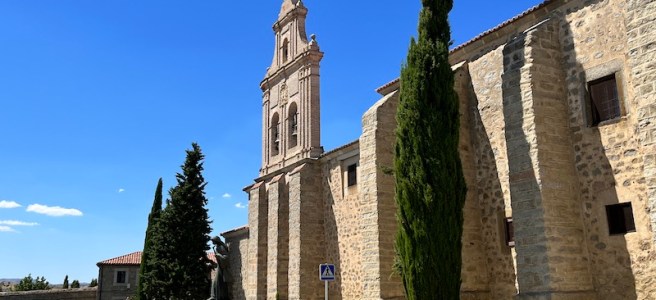
In August, I had the great delight and honor to visit la ciudad de Ávila in España. Each day I was there, I visited my favorite place, el monasterio de la Encarnación. I’d walk from the old town of Ávila down the fortified hill, and a few blocks through a neighborhood toward the monastery. Once I reached the street, Calle de la Encarnación, I could see a couple blocks away the magnificent statue of Teresa – you know the one, where she stands tall, walking staff in hand.
I would enter el patio de la Encarnación, an outdoor terrace just within the monastery walls. From where I sat on stone bench, I could see the very door through which Teresa entered the Carmelite Order in 1535. Each day, I sat there and wrote, eager to encounter Teresa and the God who so enraptured her heart. I waited and listened. I listened and waited. And then I waited some more. I figured, what better place than for divine inspiration?! I waited and listened. Nothing.
Finally, I gave up. I figured that if Teresa was going to be silent, so would I. I put away my notebook and pencil and walked out. But I couldn’t leave. So I started to wander around outside, down the street past the main entrance of the monastery. I followed the outer walls of Encarnacion, curious about the space that Encarnación occupied. It was not a short walk. The property was much more extensive than I ever imagined. I was getting tired, and the heat of the day was relieved only by the coolness radiating from the stones of the massive walls.
After what seemed like an impossible number of left-hand turns, I started to recognize things again, and up ahead I could see Calle de la Encarnación again. As I neared the crossroads, ready to take my final left to get back to the main entrance, I saw a sign. That’s right, a sign. A STOP sign to be exact. Below it were the words, “Convento de San José (Las Madres) Primero Fundación de Santa Teresa de Jesús”. Next to the words was an arrow. The arrow, slight though it was, pointed in the opposite direction of Encarnación.
It is then that I remembered. Teresa left. She left Encarnación. She left and she set out. She left what had been her home and her local community of many years. Familiar walls, familiar faces, familiar routine, familiar spaces to encounter God. She left. The statue that we love so much and that is replete with emotion and intensity and meaning. With walking staff in hand, Teresa is setting out to re-found the Carmelite order. Her back is to Encarnación, and her face is set like flint, heading towards San José, the first convent of the Carmelite reform.
The woman from today’s gospel is no different. She encountered Jesus not in a monastery but in a familiar place — Jacob’s well. The well dated back nearly 2 millennia to the time of Jacob in the land of Samaria, in the town of Sychar, “near the plot of land that Jacob had given to his son Joseph” (John 4:5). It was familiar not only to the woman but to her ancestors who day after day, year after year, came to draw water.
Jesus presented the woman with a crossroads. He asked her to let go of the familiar and to draw water not from this spring that had served her and her people for years, but to draw living water, that is, water flowing from God’s endless spring of Wisdom. It is the Wisdom we hear about in our first reading, “I loved Her more than health and beauty; I preferred Her to the light of day, for Her countenance shone unceasingly.” (Wisdom 7:10)
The woman couldn’t believe what she was hearing from Jesus. “Who do you think you are?” she says to Jesus. (John 4:12). Perhaps she even wondered to herself, “Who do I think I am to receive this water?” Still, she waited and listened, longing for more.
And then she gets it.
She leaves her water jar behind and sets out. Her faith is being refounded – what it looks like, she’s not sure – but she sets out to live that refounding and share it with others.
Are we not at this same place? Are we not at a crossroads and being invited to leave the familiar and to set out for the new?
Even when the signs are clear, we don’t always know what to do or how to take a next step. When I stood at the crossroads – Encarnación to my left and the refoundation of San Jose on my right – I’m proud to say that I took the road most traveled. I turned left to Encarnación.
You see I love everything that Encarnación stands for. I love the peace and calm I feel. I love the cast-iron handle that I can grasp and pull open just as Teresa did some years ago. But I still had to go. I’d like to say that I set my face like flint and headed for San Jose, but instead I went into town, and sat in la plaza, surrounded by the night life of Ávila. I resigned myself to peanuts and beer.
It is then that Teresa came and sat down beside me. Her presence is as unmistakable to me as our communion of IHM saints “dwelling now in light yet ever near”.
“Go,” she said. From Encarnación to San Jose. Go. From the walls to the city, to the fields to the rock-strewn paths and the sun-scorched plains. Go.”
For Teresa to go, for the woman at the well to go, and for us to go, we must draw richly from the well of living water. We must leave behind the familiar, leave behind even the water jug that has served us so well. What does this look like?
I’m reminded of a few stories I heard over the past few days:
- the couple in their 60s who overnight find themselves to be parents and grandparents as they adopt a young woman and her child as their own
- the school board who chooses to welcome with open arms a student who is transgendered
- the religious sister who places her body literally in the crossfire of warring nations in order to ensure peace and safety for all
- the middle-aged mechanic who in the midst of anxiety and depression, chooses not to give up on themselves
This is what it looks like to have living water flowing through you – to be open to and to live into God’s invitation to life, even when it seems unfamiliar, absurd, unpopular, or terrifying.
What crossroads are we at today – as individuals, as families and religious congregations, as nations and an earth community? Where are the wells inside of us and around us from which we are called to draw living water?
Wait and listen.
Then go …
… from Encarnación to San Jose. Go. From the walls to the city, to the fields to the rock-strewn paths and the sun-scorched plains. Go.
image credit: julie vieira

 julie vieira