the acts of the apostles continue

Wednesday of the Seventh Week in Ordinary Time
Lectionary: 343

Acts 5:17-26 
Psalm 34:2-3, 4-5, 6-7, 8-9
John 3:16-21

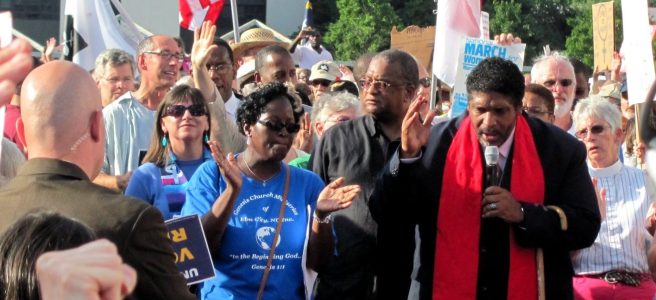
On Monday of this week, Rev. William Barber along with two others were arrested while praying on the steps of the Capitol. Reverend. Barber – a public theologian and co-chair of the Poor People’s Campaign among many other things – he along with those gathered prayed, “We are here crying to you, Oh, God, because we have heard the cries of your people.” (source)

“We have heard the cries of your people” and for that prayer, for that proclamation of the most basic tenets of the Gospel, they were arrested and threatened with jail. 

I can’t help but think of the Apostles in today’s readings:

“The high priest … filled with jealousy, laid hands upon the Apostles and put them in the public jail.”  (Acts 5:17-18)

The Acts of the Apostles are not stories from a bygone era; they are Acts happening day by day as the People of God stand strong and true, prayerful and passionate, calling for – working for – peace and justice on behalf of the kindom of God.

What a reprieve the Apostles had in that man-made, hate-made structure meant to imprison not just their bodies but their prayers, their words and their actions! The angel of the Lord appears and sets them free. Free not to return quietly to their homes or to exile under the cover of night, but to go back in the light of day to pray, to speak words, and to stand for and with the people of God. They stood in the light of day, ready once again to proclaim, “We have heard the cries of your people”, and to risk imprisonment once again.

But what is the risk of imprisonment, when the risk of the life of the people – especially those who are among the most vulnerable and poor – is constantly under threat? And not just threat, but grave harm and even death?

The Acts of the Apostles in the early Church and the Acts of the Apostles today are not man-made, hate-made. They are the Acts of “Apostolos”, which is Greek for “ones who are sent out”. They are ones who are call for ecclesial and societal transformation in order to build the kindom of God, not the kingdom of men. They call for reform and they also call for a new way of doing things that is meant for all creation, including those who seek to imprison them. 

They are people who have heard the words “God so loved the world” and wept. They know, beyond the shadow of a doubt, that God sent God’s own Beloved into the world – not to condemn the world – but that the world might be saved. (John 3:16)

Saved by love. Not money or power. Saved by love. Not singularity or arrogance. Saved by love. Love stirs within the hearts of the Apostles. And it stirs within you and me. What Acts will you Apostles write today? What small acts of kindness — or resistance — will you proclaim with your lives this day?

.

image : Rev. William Barber speaking at a Moral Monday rally on July 15, 2013 ; photo by Ted Buckner

the unknown God

Wednesday of the Sixth Week of Easter
Lectionary: 293

Acts 17:15, 22—18:1
Psalm 148:1-2, 11-12, 13, 14
John 16:12-15

The past few weeks I’ve been working on a presentation at Visitation on my fave theologian, and the subject of my master’s degree, Karl Rahner. I will spare you the long list of reasons why I love Rahner. However I would be remiss if I missed an opportunity to mention Rahner’s insight into understanding God as Holy Mystery. God is the one who is “incomprehensible and impenetrable”. God is the nameless one, the infinite horizon.

Of course my ears perked up with today’s reading from Acts where Paul speaks about the Athenians’ shrine to “the unknown God”. Now I don’t want to be anachronistic in any way, but I do think there’s an interesting connection between the Athenians’ experience of the sacred as unknown and the emerging Christological sense of the sacred as mystery.

The Athenians liked gods – the major Olympian gods like Zeus and Athena and the minor gods like Pan and the Muses. They even paid homage to the titans. Athens was so inclusive and welcoming that their city boasted shrines to all kinds of deities beyond their own religious circle. They were “inherently hospitable to new gods, ideas, and interpretations” (source). The Athenians were also careful. They erected a shrine to “the unknown God” just to make sure they’d covered all their bases. For they did not wish to offend any deity, even one they did not know.

Paul rightly observes “that in every respect [they] are very religious” (Acts 17:22). What’s interesting to me is that he doesn’t make an issue of any of the shrines. He doesn’t try to bring his Christian message into dialogue with Artemis or Dionysius. Instead, he focuses on this one particular shrine to the unknown God. There’s something about the “unknownness” of this particular deity that Paul finds a connection with. He takes the opportunity to make the connection between this unknowable God, and the God whom he knows intimately. This God, he says, is in fact very much known – not “fashioned from gold, silver, or stone by human art and imagination” but a living God in whom “we live and have our being”, a God who makes Godself known through Jesus the Christ.

Some have read this passage as Paul pointing out their folly and reprimanding the Athenians for the foolishness of worshiping a deity that they did not know. But I don’t think so. Paul knew the ways of the Greek world – he spoke Greek and was well versed in Greek philosophy. There was something about the unknown God that resonated with him and compelled him to begin there, rather than with the very knowable (and rather fallible) deities of the Greek world.

Although Paul did not have the benefit 20th century philosophical concepts or theological language of Rahner, it’s clear that he also has had a fundamental experience of God as mystery – and God as revealed, knowable. He speaks of this throughout his preaching. He is passionate about sharing this with the Greeks, to help them make the connection between the unknown and the known.

In our life today, we have many things that remain unknown to us, not just God. There’s our health, our relationship⁠s⁠ – I don’t even know what I’m having for lunch today! I’d like to be able to flip a switch – from unknown to known, from hidden to revealed, but that’s not how mystery works. It’s something we have to not only live into, but embrace. It’s in the dance of mystery that we find our creativity, our passion, and our zeal.

Perhaps we can take a page out of Paul’s playbook. To respect the places of unknown and mystery that we find ourselves in and to also begin to move around it, start to find shapes and patterns, colors and textures in the midst of the unknown. In doing so, we begin to name what has been unnamable, reveal what has been hidden.

It doesn’t mean that it’s easy nor that it wont have discomfort, suffering or pain. In today’s gospel, Jesus promises that we are not alone in this and that we do not have to bear everything alone. The Spirit is truly with us.

As we “live and have our being” today, let us be on the look out experiences of the unknown and known – and not be afraid to dance with this mystery.

Image Credit: Kamil Feczko on Unsplash