
the acts of the apostles continue

Wednesday of the Seventh Week in Ordinary Time
Lectionary: 343

Acts 5:17-26 
Psalm 34:2-3, 4-5, 6-7, 8-9
John 3:16-21

On Monday of this week, Rev. William Barber along with two others were arrested while praying on the steps of the Capitol. Reverend. Barber – a public theologian and co-chair of the Poor People’s Campaign among many other things – he along with those gathered prayed, “We are here crying to you, Oh, God, because we have heard the cries of your people.” (source)

“We have heard the cries of your people” and for that prayer, for that proclamation of the most basic tenets of the Gospel, they were arrested and threatened with jail. 

I can’t help but think of the Apostles in today’s readings:

“The high priest … filled with jealousy, laid hands upon the Apostles and put them in the public jail.”  (Acts 5:17-18)

The Acts of the Apostles are not stories from a bygone era; they are Acts happening day by day as the People of God stand strong and true, prayerful and passionate, calling for – working for – peace and justice on behalf of the kindom of God.

What a reprieve the Apostles had in that man-made, hate-made structure meant to imprison not just their bodies but their prayers, their words and their actions! The angel of the Lord appears and sets them free. Free not to return quietly to their homes or to exile under the cover of night, but to go back in the light of day to pray, to speak words, and to stand for and with the people of God. They stood in the light of day, ready once again to proclaim, “We have heard the cries of your people”, and to risk imprisonment once again.

But what is the risk of imprisonment, when the risk of the life of the people – especially those who are among the most vulnerable and poor – is constantly under threat? And not just threat, but grave harm and even death?

The Acts of the Apostles in the early Church and the Acts of the Apostles today are not man-made, hate-made. They are the Acts of “Apostolos”, which is Greek for “ones who are sent out”. They are ones who are call for ecclesial and societal transformation in order to build the kindom of God, not the kingdom of men. They call for reform and they also call for a new way of doing things that is meant for all creation, including those who seek to imprison them. 

They are people who have heard the words “God so loved the world” and wept. They know, beyond the shadow of a doubt, that God sent God’s own Beloved into the world – not to condemn the world – but that the world might be saved. (John 3:16)

Saved by love. Not money or power. Saved by love. Not singularity or arrogance. Saved by love. Love stirs within the hearts of the Apostles. And it stirs within you and me. What Acts will you Apostles write today? What small acts of kindness — or resistance — will you proclaim with your lives this day?

.

image : Rev. William Barber speaking at a Moral Monday rally on July 15, 2013 ; photo by Ted Buckner
where is wisdom?

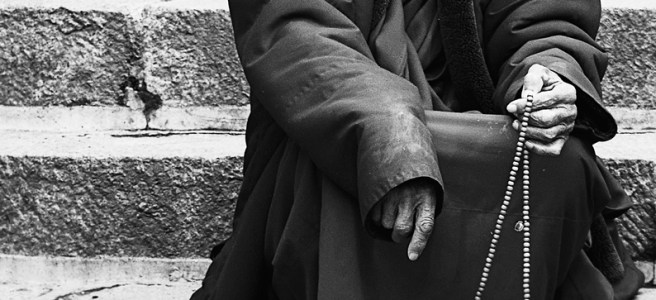
monk holding prayer beads

Wednesday of the Seventh Week in Ordinary Time
Lectionary: 343

Sirach 4:11-19
Psalm 119:165,168,171,172,174,175
Mark 9:38-40

Where is the wisdom we have lost in knowledge?

― T.S. Eliot in The Waste Land and Other Poems

Look around you. Look within you. Gathered in the beautiful and fragile pieces of our lives, Wisdom is here.

  • Wisdom is in the wood and stone of our homes that have stood witness day after day to our joys and sorrows, praises and lamentations.
  • Wisdom is in the books and rosary beads worn smooth from decades of prayer.
  • Wisdom is in our tired bodies that often creak like wooden pews yet persist, nevertheless, in holding the spaciousness that welcomes God.

Wisdom is here.

In the time of the Hebrew Scriptures, wisdom was traditionally associated with rulers. In Proverbs 8:15, for example, it says that it is through Wisdom that “kings reign and princes decree justice”. Leaders such as Solomon were known for their wisdom and for praying that God might help them support and guide the people.

Yet in today’s passage from Sirach, something new is unfolding. The Wisdom about which Sirach speaks goes beyond this traditional understanding of Wisdom. Wisdom is something that not located in one leader or person but is present in all of creation.

Wisdom is here. Wisdom is in you, wisdom is in me, and wisdom is in the “we”.

Jesus echoes this turn in understanding Wisdom when in Mark 9:38-40 John confronts him with the news that non-disciples are healing people in Jesus’ name. Jesus’ response is open and spacious, unthreatened and sure. He affirms the power of God within not only those “officially designated” to act in his name, but all who embrace that deep inner call to follow the path of the Gospel. Like Sirach, Jesus understands that the gifts of God are not for the designated few, but for all.

Wisdom is here.

This Wisdom that we hold, and which holds us, is indeed the greatest of all gifts. Recall how Solomon, who as King could ask for anything and make it happen with all his power and money, asked only for this – Wisdom – not for self-serving rewards like long life or the death of his enemies, but for Wisdom.

My dear sisters and brothers and kin, we live today in deeply troubled times. It seems that Wisdom itself has been fired from its job. It is understandable that in the face of chaos and overwhelm, we respond again and again with the words, “I don’t know”.

“I don’t know what to do”.
“I don’t know how to survive this”.
“I don’t know how to help”.
“I don’t know how to make a difference”.

It feels awful to say, “I don’t know”, yet these three words are not words of resignation, nor of weakness, nor of inaction. No. In fact, these words are powerful beyond measure.

“I don’t know” is the doorway to Wisdom. It is the soul opening up to the more, the depths, the spaciousness within which we must dwell always, but most especially in troubling times.

Wisdom calls us to discern, to see things from God’s perspective. We must trust that what we need to know, what we need to do, will emerge. And as Sirach writes, when we trust Wisdom, wisdom will reveal to us “treasures of knowledge and an understanding of justice.” (Sirach 4:17-18)

Wisdom is here. Wisdom is in you, wisdom is in me, and wisdom is in the “we”.

Remember who you are, and whose you are. Speak the power of the words “I don’t know” and allow yourself to sink deeply into the Wisdom that is breathing within you. Speak the words “I don’t know” again and again and explore that emptiness – “Wisdom’s inmost chambers” as scripture says – within which God reveals Godself. Speak the words “I don’t know” in the solitude of your heart and in the midst of community.

Wisdom is here.

.

image : “Worn Wisdom” by Aaron Greenwood on Unsplash

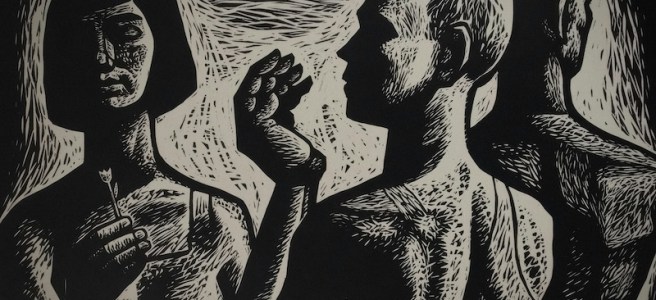
possessed. lunatics. paralytics.

Monday after Epiphany
Lectionary: 212

1 John 3:22–4:6
Psalm 2:7bc-8, 10-12a
Matthew 4:12-17,23-25

Possessed. Lunatics. Paralytics.

These three words caught me as I prayed with today’s readings.

Like many of us, I am very sensitive to the use of language and how words can hurt, especially when they are used to dismiss the experience of others.

Matthew was intentional about using these words for he wanted to show that it was the people who were treated as outcasts – demonized, ridiculed, diseased, crazy, and just plain unworthy – that were among the people who not only heard but could take to heart the person and message of Jesus.

It is among the possessed, lunatics and paralytics that Jesus drew close. In Matthew’s account, Jesus doesn’t interview them ahead of time to assess their worthiness or to judge their supposed deviance. He knows what it’s like to be disregarded and pushed out just because of who he is. Jesus makes no moral judgements about the people as a condition of loving them. He just draws close in love and heals them. Jesus pays no heed to the accusations of others about them. Who knows? There could have been legitimate transgressions or concerns and there could also have been trumped up charges, fake news or plain old fear because these people were different from what was considered “normal”. Jesus did not judge. Before him were people whom he would not separate himself from.

Possessed. Lunatics. Paralytics.

Life was rough for them. The minority population always struggles in the majority. It’s hard enough to be different for whatever reason, it’s even harder living in a world that deals harshly with anything and anyone who doesn’t fit. We Christians and religious do our best to follow Jesus in embracing everyone, including those who are different. But sometimes our language and actions bely our own fear of those who are different. They may be subtle microaggressions or fully intentional acts that discriminate and hurt.

What I love about this passage is that Jesus indiscriminately lets the people come to him.

They brought to him all who were sick with various diseases and racked with pain, those who were possessed, lunatics, and paralytics, and he cured them. (Matthew 4:24)

He cured them. He cured them all. And many became his dear friends and followers.

It must have felt nice for persons who had suffered marginalization to find a place where they felt at home, loved, and on a mission they cared about. Maybe they were still using their crutches or had occasional meltdowns or had to struggle to cope with their demons. But they were there. Side by side with Jesus.

It takes me back to our first reading where each of us is address as Beloved. Perhaps this should always be where we begin any encounter with the other. Not the things we fear about them – possessed, lunatics, paralytics – but who they most truly are. Beloved.

.

image : “Maa ootab” (The earth is waiting) by Herald Eelma, Estonia 1964

do not give into the weaponization of division

Memorial of Saint Frances Xavier Cabrini, Virgin
Lectionary: 493

Titus 3:1-7
Psalm 23:1-6
Luke 17:11-19

I can’t say that I am particularly enamored of first reading today. The first verse reminding the people “to be under the control of magistrates and authorities, to be obedient” struck a raw nerve with me particularly in light of how much we as a country have wrestled with what kind of leader we want and how we expect our government to serve “we the people”.

The author of the letter to Titus has a thing for keeping the peace in terms of the law and the household. The author, who wrote in the Apostle Paul’s name, insists that everyone play their part and dutifully fulfill their roles and responsibilities. This is not necessarily a bad thing, but it becomes a problem when those roles and responsibilities are shaped by an ideology that grants some people their full human dignity while simultaneously denying it for others.

Though a member of the Christian community, the author of the letter to Titus sometimes reflects more the society around him, than the life of following Jesus the Christ. This particular section of his letter comes on the heels of his exhortations to “older women” that they be

reverent in their behavior, not slanderers, not addicted to drink, teaching what is good so that they may train younger women to love their husbands and children, to be self-controlled, chaste, good homemakers under the control of their husbands, so that the word of God may not be discredited. (Titus 2:3-5)

“Duties for older and younger men are stated, but their duties are not connected to the household: their behavior to their wives and children is not mentioned.” (Joanna Dewey, “Titus” in Women’s Bible Commentary, 604) Similarly, while slaves are exhorted to obey their masters, there is no mention of the responsibilities of the masters in how to treat people who are enslaved. (Titus 2:9-10)

On the one hand, I can’t blame the author of Titus for reaffirming the status quo. Nobody wants mayhem. Nobody wants mass chaos. (The author doesn’t yet see how the status quo is also responsible for dehumanizing women and enslaved persons.)

On the other hand, the author of Titus knows better. He’s the same guy who eloquently calls people to “be peaceable, considerate, exercising all graciousness toward everyone.” And it is Titus who recognizes that we know how to be this way because of the mercy, “kindness and generous love of God”. (3:4-5)

In the new Christian communities, not only women and enslaved persons but lepers, strangers and other “normal candidates” for discrimination are given their full dignity and respect, at least as much as could be expressed at that time and place in history. Christians saw in Jesus the mercy, kindness and generous love of God extended to everyone. They also saw in Jesus one who did not discriminate based on gender, religion, age, politics, or cultural or social norms.

Reading between the lines, we see in the author of Titus a person still very much struggling to work out how everything fits together how to integrate his newfound life in Jesus and his teachings in a world that looked at values, roles and responsibilities, leadership, governance, and human dignity from a very different framework. Further, as a Christian leader, the author of Titus likely felt under pressure to conform to “the control of magistrates and authorities” so as not to cause waves for the newly-established Christian community.

His struggle was real.

And our struggle today is real too.

We live in a nation that is divided, vehemently divided. And some of our “magistrates and authorities” – as well as anyone with a fancy enough soap box – are weaponizing that divide and turning kin against one another.

We’ve got to sidestep this weaponization and not give into making enemies of our own kin, even in the name of the gospel. What do we choose to say, to do about the politics of our time from our rootedness in the mercy, kindness and generous love of God? How do we align ourselves with those who are discriminated against today (which may likely be ourselves) and at the same time reach out peaceably to our kin who would believe differently? How do we know when to angrily overturn the tables or turn the other cheek?

This is a time for deep discernment, my friends, personally and together as a community of faith.

There is work to be done.

As Jesus says to the Samaritan who was made clean from leprosy in today’s Gospel (Luke 17:19)

“Stand up and go;
your faith has saved you.”

.

image : adapted from Santiago Gaughan / The Cougar