Memorial of Saints Timothy and Titus, Bishops
Lectionary: 520/317
2 Timothy 1:1-8
Psalm 96:1-10
Mark 3:22-30
Many, many years ago, I was sitting in a high school classroom and delighted to learn that instead of religion class, we’d be watching a movie. Awesome! I thought. No lecture, no class participation, no big deal.
Fifty-six minutes later, my life was changed forever.
The movie was no movie. It was the documentary film Roses in December: The Story of Jean Donovan (1980) and it tells the story of Catholic lay woman Jean Donovan, Maryknoll Sisters Maura Clarke, MM, and Ita Ford, MM, and Ursuline Sister Dorothy Kazel, OSU. These four women were murdered in El Salvador for working with the poor by government-sanctioned military extremists whose motto was «Haz patria, mata un cura» – “Be a patriot, kill a priest.” And not just priests. Anyone who sided with the poor.
I left that classroom stunned … and with a single question in my heart: for what would I be willing to give my life – and my death?
While today is not the memorial of these 4 Churchwomen (December 2), I can’t help but be reminded of them as we reflect today on two more holy people – Timothy and Titus – who also shaped the life of the Church. We have little time to review their biographies – not because no one likes long homilies – but because we are in a state of crisis. Here and now, we need both the Word and the Table to nourish us as we are called to act by praying and pray by acting.
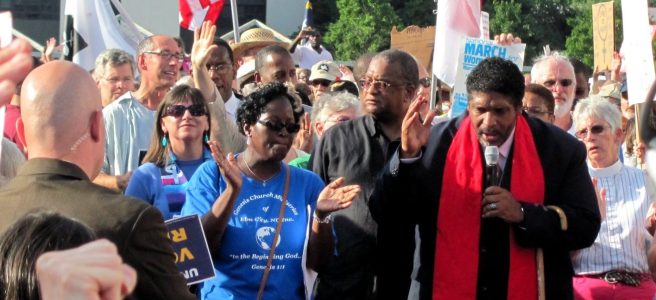
Timothy, Titus, Jean, Maura, Ita and Dorothy – they stand right alongside the leaders of today who embody the gospel – leaders such as Episcopal Bishop Rob Hirshfeld. In a reflection on January 9 at a vigil for Renee Good in Concord, New Hampshire, Bishop Hirshfeld noted that “the message of Jesus’ love, compassion, and commitment to the poor, the outcast” was comprised when the church became linked to the empire by Constantine in the 4th century. (source)
He says, “And we have lost that voice, and we are now, I believe, entering a time, a new era of martyrdom.” He cites the 4 Churchwomen as well as Oscar Romero who during mass “called upon the death squads of El Salvador to lay down their arms or risk excommunication”. He “was martyred the next Sunday at the altar.”
Hirshfeld goes on:
I have told the clergy of the Episcopal Diocese of New Hampshire that we may be entering into that same witness. And I’ve asked them to get their affairs in order—to make sure they have their wills written, because it may be that now is no longer the time for statements, but for us with our bodies to stand between the powers of this world and the most vulnerable.
And it may mean that we are going to have to act in a new way that we have never seen perhaps in our lifetime, except for these remote stories that I’ve just cited, to put our faith in the God of life, of resurrection, of a love that is stronger than death itself.
For what would I be willing to give my life – and my death?
Our response to this question, and to these witnesses of yesterday and today, will be expressed in a myriad of ways. Some are called to the streets of Minneapolis, Chicago, Portland and perhaps, one day, to our own hometown. Some are called to respond through the spaciousness of their contemplative heart. Some are called to be awake to the pain of broken relationships and broken trust. Some are called to create art and beauty in the face of desperation.
Stop. Listen. You will hear the call, and you will know how to respond.
Hear these words again from 2 Timothy 1:6-8.
I remind you to stir into flame
the gift of God that you have …
For God did not give us a spirit of cowardice
but rather of power and love and self-control.
So do not be ashamed of your testimony to our Lord …
but bear your share .. for the Gospel
with the strength that comes from God.
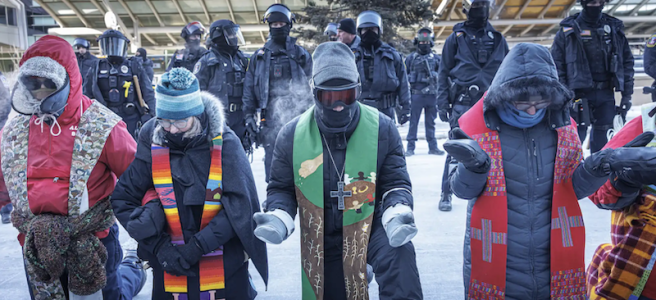
image : Photo by Kerem Yücel | MPR News
“Clergy members and community activists protest Friday in extreme subzero weather at Minneapolis-St. Paul International Airport, calling on Delta Air Lines, Signature Aviation and other companies to stop cooperating with the federal immigration enforcement surge. Police from multiple agencies detained protesters during the action.” (source)