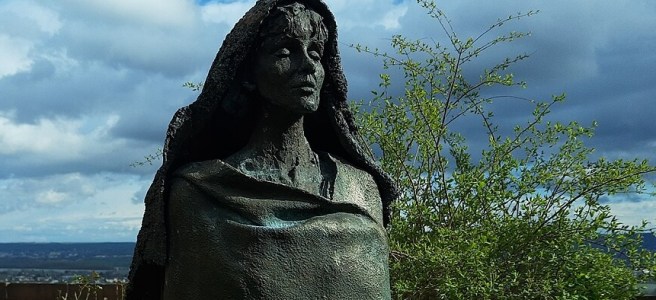
hildegard of bingen : a guiding light amidst the overwhelm

Hildegard of Bingen, bronze sculpture by Karlheinz Oswald outside Eibingen Abbey; photo by Gerda Arendt

Wednesday of the Twenty-fourth Week in Ordinary Time
Lectionary: 445

1 Timothy 3:14-16
Psalm 111:1-2,3-4,5-6
Luke 7:31-35

Our readings today feel to me like a mirror of the world we live in.

“Undeniably great is the mystery of faith,” writes Paul to Timothy and the Christian community of Ephesus which was struggling in a storm of false teachings. “God will forever be mindful of God’s covenant.” “How great are the works of the Lord” the Psalmist reminds us. And then we sing “Alleluia” only to hear the Luke proclaim in the gospel how “the world” can be like a discontent, spoiled person who refuses to see the goodness all around them.

I feel this, deep in my bones. A world of false teachings. Struggle with what seems like bad news followed by even more bad news.

Yet all around us is the glory of God.
… unkept, unspoiled, undeniable.

But unbearable is the weight of trauma. So unbearable that we can’t hear the Alleluia. We can’t remember the covenant. We can’t find the stunning mystery of the Holy One in our midst.

I don’t have the words to make sense of this. And when I find myself at a loss, I try to use whatever ounce of energy I have left to turn to one of my guiding lights.

Sometimes it’s a friend, sometimes it’s a favorite poet. Lately, I’ve turned to the stones themselves, ones I’ve collected here and there. I ask them to tell me how it’s survived millions of years — being upchucked by a volcanic eruption, tossed onto the land, and then having to stand witness as species come and go, storms come and go. … Yet still the stones remain, one right here in the palm of my hand.

And so today, with you, I turn to one of our guiding lights, Hildegard of Bingen.

We turn to her, seeking wisdom, consolation … and perhaps even reprieve from the chaos that surrounds us and threatens to erupt inside the tumultuous earth within our hearts.

She reminds us that even in the cacophony of chaos, we are not alone. God has not forgotten God’s covenant:

Every element has a sound, an original sound from the order of God; all those sounds unite like the harmony from harps and zithers.

She reminds us who we are … and whose we are:

I am the fiery life of the essence of God; I am the flame above the beauty in the fields; I shine in the waters; I burn in the sun, the moon, and the stars. And with the airy wind, I quicken all things vitally by an unseen, all-sustaining life. (Book of Divine Works)

My dear friends, when the chaos threatens to overwhelm us, let us stop and remember this.

Humanity, take a good look at yourself.  Inside, you’ve got heaven and earth, and all of creation.  You’re a world – everything is hidden in you.”  (Causes and Cures)

We ARE the fiery life of the essence of God
We are the flame above the beauty in the fields
We shine in the waters
We burn in the sun, the moon, and the stars
And with the airy wind, we quicken all things vitally by an unseen, all-sustaining life


beyond the drama

underwater whale

Wednesday of the First Week in Lent
Lectionary: 226

Jonah 3:1-10
Psalm 51:3-4,12-13,18-19
Luke 11:29-32

Not gonna lie.

I am terribly disappointed that our reading from the book of Jonah today did NOT include mention of the whale – or as Jonah calls him the “big fish”.

Sadly, we are two chapters too late.

We missed all the drama.

  • We missed Jonah fleeing from God and hopping on the first ship out of town (1:3)
  • We missed God one-upping Jonah by “hurling a great wind upon the sea” where Jonah’s boat sailed (1:4)
  • We missed the sailors regretfully picking up Jonah and throwing him into the sea (1:15)
  • We missed the large fish swallowing up Jonah (1:17) and carrying him in his belly for three days and three nights to Nineveh.

And by one measly verse, we missed the large fish vomiting Jonah upon dry land (2:11)

Instead, we get absolutely zero drama in our readings today. Not even a goldfish-sized drama.  Frankly, I think Jonah is a little surprised in this scene too, what with everything that happened to get him to Nineveh. Part of his resistance to going to Nineveh was that it was the capital of the Assyrian empire which was a constant threat to Israel. It was also well known as a violent city.

Jonah had several good reasons for not wanting to go to Nineveh:

  1. if he was not successful in his mission, the Assyrians of Nineveh would likely kill him;
  2. if he was successful, this would be even worse, because the “evil” Nineveh would be spared; and
  3. if Nineveh was spared because of their repentance, this would be a major point of humiliation for Israel who themselves had a hard time repenting.

It’s a surprise then to learn today in our readings that the “violent” Assyrians of Nineveh put up no fight to Jonah’s message. There was not even one ounce of drama to be had. In fact, scripture says:

“when [Jonah] had gone only a single day’s walk announcing, ‘Forty days more and Nineveh shall be overthrown,’ the people of Nineveh including the King believed God and repented.

Jonah 3:4-6; emphasis mine

Jonah must have been shocked at this turn of events. Perhaps in his heart he heard the quiet words the Psalmist.

“A heart contrite and humbled, O God, you will not spurn.”

Jonah 51:19

We all deal with a lot of drama in our lives. Family drama. Relationship drama. Community drama. Political drama. Health drama. And of course my favorite ego drama starring myself in all of the roles. My intention is not to minimize these experiences for they signify the intense experiences – good and/or bad – that we have negotiating our place in the world.

I really missed the whale drama today. But sometimes, like today, the drama isn’t even part of the story, but it’s a memory that we hold on to, cherished as a good or bad memory.

Our reading today is a reminder that just beyond the drama – or perhaps even a quiet pause within the drama – is dry land. It may take us 3 days and 3 nights to get there or it may take us a few seconds or years.  

In this Lenten season, we are called to be aware of the dramas of life, and also to sit quietly – be it in our easy chair, the drivers seat, a hospital bed, or the belly of a whale.

To sit quietly and allow God’s mercy and grace to hold us and perhaps even heave us into a new direction.  

.

photo : Gabriel Dizzi on Unsplash

leave it all behind

Wednesday of the Thirty-first Week in Ordinary Time
Lectionary: 487
Romans 13:8-10
Psalm 112:1b-2, 4-5, 9
Luke 14:25-33

Today we meet Jesus, ever the itinerant preacher, on the road again. He’s not traveling alone. His band of close friends and disciples has now become a great crowd of people – people who have been healed by Jesus, fed by Jesus, embraced by Jesus.

I imagine that people were feeling pretty good, perhaps even on fire in their hearts for all that they were experiencing and hearing from Jesus. They were all for trekking out into the desert, across the sea — wherever Jesus was headed.

And then he turns around and faces the crowd and says,

“If anyone comes to me without hating his father and mother,
wife and children, brothers and sisters,
and even his own life,
he cannot be my disciple.
Whoever does not carry his own cross and come after me
cannot be my disciple.” (Luke 14:26)


                        …
                                               …

The silence is palpable. This road trip just got real.

How could Jesus say those things? Hate my those who have taken care of me? Hate my partner, my best friend, my siblings, and children? Hate myself?

I think there may be times in our life where we have wanted to banish everything from our life and focus on God alone. Let it all go, cut ourselves off, and live with single-hearted devotion to God. Many of us have even gone so far as to hate self – especially if we have been taught that we are not good enough, less than, or worthless. We have no problem denying ourselves and carrying our own cross because that’s what we’ve done our whole lives!

But we know Jesus better than this. Jesus is love, not hatred. What does he mean then when he says that to follow him is to hate everyone else?

“Hate” is a strong word and scholars say that it was likely used intentionally by Jesus. His use of the word reflects a Jewish style of argument used to demonstrate the force or passion underlying Jesus message, and that is, the importance of loving God above all else. That doesn’t mean to hate or vilify anyone; rather “hate” in this context is understood more in the sense of “love less”. Now that idea of loving less sounds like a negative.

“I love you, ehh, but I love you less than I love Billie.”

I’d be kinda hurt by that!

But I think when Jesus invites us to love God more, it’s not about a hierarchy of love, it’s not a binary of better or worse. Love is not quantifiable. It’s more like what Margaret Brennan taught me when I entered the community – all of your affections get rearranged. I think that’s true here to. When Jesus calls us to follow him, we need to rearrange our “affections” – our relationships, our priorities, what we give our energy to.

And so yes, let go of everything. Be willing to trek out into the desert, to cross the tumultuous seas, to make adjustments in relationships and rearrange priorities. But love? Don’t give that up.

As Paul writes to the Roman community, “Owe nothing to anyone, except love.”

“Owe nothing to anyone, except love.”

Have no attachments, nothing that binds you – except love.

photo : Ioana Cristiana on Unsplash