hildegard of bingen : a guiding light amidst the overwhelm

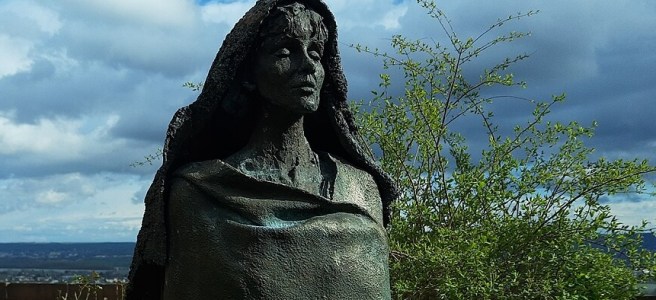
Hildegard of Bingen, bronze sculpture by Karlheinz Oswald outside Eibingen Abbey; photo by Gerda Arendt

Wednesday of the Twenty-fourth Week in Ordinary Time
Lectionary: 445

1 Timothy 3:14-16
Psalm 111:1-2,3-4,5-6
Luke 7:31-35

Our readings today feel to me like a mirror of the world we live in.

“Undeniably great is the mystery of faith,” writes Paul to Timothy and the Christian community of Ephesus which was struggling in a storm of false teachings. “God will forever be mindful of God’s covenant.” “How great are the works of the Lord” the Psalmist reminds us. And then we sing “Alleluia” only to hear the Luke proclaim in the gospel how “the world” can be like a discontent, spoiled person who refuses to see the goodness all around them.

I feel this, deep in my bones. A world of false teachings. Struggle with what seems like bad news followed by even more bad news.

Yet all around us is the glory of God.
… unkept, unspoiled, undeniable.

But unbearable is the weight of trauma. So unbearable that we can’t hear the Alleluia. We can’t remember the covenant. We can’t find the stunning mystery of the Holy One in our midst.

I don’t have the words to make sense of this. And when I find myself at a loss, I try to use whatever ounce of energy I have left to turn to one of my guiding lights.

Sometimes it’s a friend, sometimes it’s a favorite poet. Lately, I’ve turned to the stones themselves, ones I’ve collected here and there. I ask them to tell me how it’s survived millions of years — being upchucked by a volcanic eruption, tossed onto the land, and then having to stand witness as species come and go, storms come and go. … Yet still the stones remain, one right here in the palm of my hand.

And so today, with you, I turn to one of our guiding lights, Hildegard of Bingen.

We turn to her, seeking wisdom, consolation … and perhaps even reprieve from the chaos that surrounds us and threatens to erupt inside the tumultuous earth within our hearts.

She reminds us that even in the cacophony of chaos, we are not alone. God has not forgotten God’s covenant:

Every element has a sound, an original sound from the order of God; all those sounds unite like the harmony from harps and zithers.

She reminds us who we are … and whose we are:

I am the fiery life of the essence of God; I am the flame above the beauty in the fields; I shine in the waters; I burn in the sun, the moon, and the stars. And with the airy wind, I quicken all things vitally by an unseen, all-sustaining life. (Book of Divine Works)

My dear friends, when the chaos threatens to overwhelm us, let us stop and remember this.

Humanity, take a good look at yourself.  Inside, you’ve got heaven and earth, and all of creation.  You’re a world – everything is hidden in you.”  (Causes and Cures)

We ARE the fiery life of the essence of God
We are the flame above the beauty in the fields
We shine in the waters
We burn in the sun, the moon, and the stars
And with the airy wind, we quicken all things vitally by an unseen, all-sustaining life

do not give into the weaponization of division

Memorial of Saint Frances Xavier Cabrini, Virgin
Lectionary: 493

Titus 3:1-7
Psalm 23:1-6
Luke 17:11-19

I can’t say that I am particularly enamored of first reading today. The first verse reminding the people “to be under the control of magistrates and authorities, to be obedient” struck a raw nerve with me particularly in light of how much we as a country have wrestled with what kind of leader we want and how we expect our government to serve “we the people”.

The author of the letter to Titus has a thing for keeping the peace in terms of the law and the household. The author, who wrote in the Apostle Paul’s name, insists that everyone play their part and dutifully fulfill their roles and responsibilities. This is not necessarily a bad thing, but it becomes a problem when those roles and responsibilities are shaped by an ideology that grants some people their full human dignity while simultaneously denying it for others.

Though a member of the Christian community, the author of the letter to Titus sometimes reflects more the society around him, than the life of following Jesus the Christ. This particular section of his letter comes on the heels of his exhortations to “older women” that they be

reverent in their behavior, not slanderers, not addicted to drink, teaching what is good so that they may train younger women to love their husbands and children, to be self-controlled, chaste, good homemakers under the control of their husbands, so that the word of God may not be discredited. (Titus 2:3-5)

“Duties for older and younger men are stated, but their duties are not connected to the household: their behavior to their wives and children is not mentioned.” (Joanna Dewey, “Titus” in Women’s Bible Commentary, 604) Similarly, while slaves are exhorted to obey their masters, there is no mention of the responsibilities of the masters in how to treat people who are enslaved. (Titus 2:9-10)

On the one hand, I can’t blame the author of Titus for reaffirming the status quo. Nobody wants mayhem. Nobody wants mass chaos. (The author doesn’t yet see how the status quo is also responsible for dehumanizing women and enslaved persons.)

On the other hand, the author of Titus knows better. He’s the same guy who eloquently calls people to “be peaceable, considerate, exercising all graciousness toward everyone.” And it is Titus who recognizes that we know how to be this way because of the mercy, “kindness and generous love of God”. (3:4-5)

In the new Christian communities, not only women and enslaved persons but lepers, strangers and other “normal candidates” for discrimination are given their full dignity and respect, at least as much as could be expressed at that time and place in history. Christians saw in Jesus the mercy, kindness and generous love of God extended to everyone. They also saw in Jesus one who did not discriminate based on gender, religion, age, politics, or cultural or social norms.

Reading between the lines, we see in the author of Titus a person still very much struggling to work out how everything fits together how to integrate his newfound life in Jesus and his teachings in a world that looked at values, roles and responsibilities, leadership, governance, and human dignity from a very different framework. Further, as a Christian leader, the author of Titus likely felt under pressure to conform to “the control of magistrates and authorities” so as not to cause waves for the newly-established Christian community.

His struggle was real.

And our struggle today is real too.

We live in a nation that is divided, vehemently divided. And some of our “magistrates and authorities” – as well as anyone with a fancy enough soap box – are weaponizing that divide and turning kin against one another.

We’ve got to sidestep this weaponization and not give into making enemies of our own kin, even in the name of the gospel. What do we choose to say, to do about the politics of our time from our rootedness in the mercy, kindness and generous love of God? How do we align ourselves with those who are discriminated against today (which may likely be ourselves) and at the same time reach out peaceably to our kin who would believe differently? How do we know when to angrily overturn the tables or turn the other cheek?

This is a time for deep discernment, my friends, personally and together as a community of faith.

There is work to be done.

As Jesus says to the Samaritan who was made clean from leprosy in today’s Gospel (Luke 17:19)

“Stand up and go;
your faith has saved you.”

.

image : adapted from Santiago Gaughan / The Cougar