
“Advent, take me away!” ummmm … yeah, no.

photo of muddy water splashing by Dmytro Bukhantsov entitled "Mud Improvisation: "The Accidental Artist" in Ukraine, Chernihiv region (2020)

Monday of the First Week of Advent
Lectionary: 175

Isaiah 4:2-6 
Psalm 122:1-9
Matthew 8:5-11

The season of Advent brings the beginning of a new Church year, and it also brings a palpable shift in the tone and cadence of our lectionary readings.

The last readings of the before Advent were rather epic, apocalyptically speaking. The prophet Daniel spoke of an anguished spirit, of visions of terrifying beasts—the greatest of which “devouring and crushing with its iron teeth and bronze claws” and “trampling with its feet” everything within its reach. (Daniel 7:19) In the gospel that follows, Jesus seems to confirm Daniel’s visions with strict warnings that people stay vigilant, lest they too find themselves on the receiving end of such tribulation.

Literally overnight, the church shifts into poetic, almost lyrical language. Just hearing the word “Advent”, seems to generate a little more pep in our liturgical step. And so today we can proclaim with the psalmist, “Come! Let us go rejoicing to the house of the Lord!” (Psalm 122)

I don’t know about you, but my personal disposition doesn’t always match up with the liturgical seasons. Sometimes I’m still in Good Friday well after Pentecost!

As I enter the Advent season, I find myself tentative, wondering if I’m stuck forever in Ordinary Time dealing with the vissitudes of everyday life as well as the endless litany of  metaphorical beasts. I flinch a little bit as I enter the readings, my loins girded, ready to fight the good fight.

Unfortunately, Isaiah does not disappoint me. In the first reading, the prophet serves up – shall we say – an “interesting” metaphor of menstruation. He says:

The Lord shall wash away
the filth of the daughters of Zion,
and purge Jerusalem’s blood from her midst
with a blast of searing judgment … (Isaiah 4:4)

[Note: I leave this for Isaiah to mansplain at another time.] But really, “blasts of searing judgement”? This is not what I expect from Advent. I do not want to be lectured about filth and blood; I want to be transported to into a new space.

Yet perhaps this start to the First Monday of Advent is indeed apropos. Advent is not a promised escape from stress like the classic catchphrase, “Calgon, take me away!” Advent is a happening within the very midst of our everyday lives. God enters into the fray with us and, as Isaiah does eventually say, God provides us with “shelter and protection: shade from the parching heat of day, refuge and cover from storm and rain” – even on the heaviest of days.

I have the sense that the Centurion of today’s Gospel understands the truth of Advent far better than I do. It would have been nice if he could have had a retreat day or week, some time off to go and find Jesus and sit at his feet, resting in the peace and healing of this “guru”. But he knows that’s not going to happen anytime soon. He is in Ordinary Time and doesn’t even have a moment for a smoke break from his command post in Capernaum. He doesn’t have the opportunity to attend a miraculous wedding feast or a life-changing event at the River Jordan. What he longs for, he cannot go to, he cannot reach out and grasp; that is, he cannot make his servant well.

What happens? We know that the Centurion does not leave to find Jesus. In fact, Jesus himself shows up in Capernaum. The very one who can heal and give life, shows up in the midst of the filth and blood, the ordinary and rough stuff of everyday life.

The Centurion wastes no time, for time is not a luxury that he has.  

“Lord, I am not worthy to have you enter under my roof;
only say the word and my servant will be healed.” (Matthew 8:8)

In other words, it’s like the Centurion is saying, “Look, Jesus. Let’s be real. Things are a mess right now. I need you, and I’m stoked that you were willing to come out and meet me where I am. It’s not pretty, but it’s where I am. I know who you are, and I have faith in you. You have a power that moves mountains and heals the sick and broken-hearted. I need for you to do that for someone I care about who needs you. Only say the word …

We can learn a lot from this person of such integrity and faith. Advent is not a time to checkout and “leave the world”. True, we always need to retreat every so often. But the Season of Advent is not a month-long pass to abscond ourselves from our own humanity – with all its filth and blood right alongside near occasions of grace and healing and wisdom and mystery.

Isaiah implores us to look around us for that smoking cloud by day or a light of flaming fire by night. Look, he says, to the ordinary things of life – which for us might be a cloudy day, or a cozy blanket at night – whatever it is, to trust that you will alight upon a pathway bringing shelter, protection, and refuge.

What are the ordinary things of life that light up before you? that invite you to wonder? that cause your heart to ache? Think on these things, follow them, and see where the Spirit leads during this most holy season of Advent.

image : “Mud Improvisation: ‘The Accidental Artist'” by Dmytro Bukhantsov
Chernihiv region of Ukraine, 2020
hildegard of bingen : a guiding light amidst the overwhelm

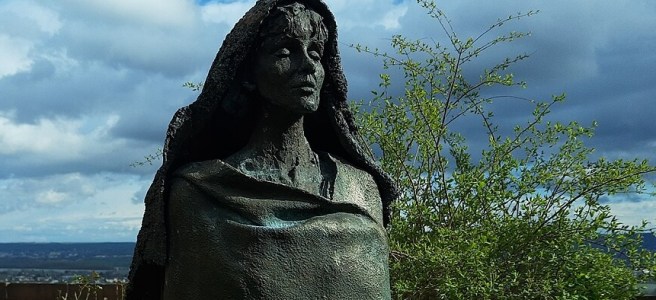
Hildegard of Bingen, bronze sculpture by Karlheinz Oswald outside Eibingen Abbey; photo by Gerda Arendt

Wednesday of the Twenty-fourth Week in Ordinary Time
Lectionary: 445

1 Timothy 3:14-16
Psalm 111:1-2,3-4,5-6
Luke 7:31-35

Our readings today feel to me like a mirror of the world we live in.

“Undeniably great is the mystery of faith,” writes Paul to Timothy and the Christian community of Ephesus which was struggling in a storm of false teachings. “God will forever be mindful of God’s covenant.” “How great are the works of the Lord” the Psalmist reminds us. And then we sing “Alleluia” only to hear the Luke proclaim in the gospel how “the world” can be like a discontent, spoiled person who refuses to see the goodness all around them.

I feel this, deep in my bones. A world of false teachings. Struggle with what seems like bad news followed by even more bad news.

Yet all around us is the glory of God.
… unkept, unspoiled, undeniable.

But unbearable is the weight of trauma. So unbearable that we can’t hear the Alleluia. We can’t remember the covenant. We can’t find the stunning mystery of the Holy One in our midst.

I don’t have the words to make sense of this. And when I find myself at a loss, I try to use whatever ounce of energy I have left to turn to one of my guiding lights.

Sometimes it’s a friend, sometimes it’s a favorite poet. Lately, I’ve turned to the stones themselves, ones I’ve collected here and there. I ask them to tell me how it’s survived millions of years — being upchucked by a volcanic eruption, tossed onto the land, and then having to stand witness as species come and go, storms come and go. … Yet still the stones remain, one right here in the palm of my hand.

And so today, with you, I turn to one of our guiding lights, Hildegard of Bingen.

We turn to her, seeking wisdom, consolation … and perhaps even reprieve from the chaos that surrounds us and threatens to erupt inside the tumultuous earth within our hearts.

She reminds us that even in the cacophony of chaos, we are not alone. God has not forgotten God’s covenant:

Every element has a sound, an original sound from the order of God; all those sounds unite like the harmony from harps and zithers.

She reminds us who we are … and whose we are:

I am the fiery life of the essence of God; I am the flame above the beauty in the fields; I shine in the waters; I burn in the sun, the moon, and the stars. And with the airy wind, I quicken all things vitally by an unseen, all-sustaining life. (Book of Divine Works)

My dear friends, when the chaos threatens to overwhelm us, let us stop and remember this.

Humanity, take a good look at yourself.  Inside, you’ve got heaven and earth, and all of creation.  You’re a world – everything is hidden in you.”  (Causes and Cures)

We ARE the fiery life of the essence of God
We are the flame above the beauty in the fields
We shine in the waters
We burn in the sun, the moon, and the stars
And with the airy wind, we quicken all things vitally by an unseen, all-sustaining life

and Joseph wept

Wednesday of the Fourteenth Week in Ordinary Time
Lectionary: 385

Genesis 41:55-57; 42:5-7a, 17-24a
Psalm 33:2-3, 10-11, 18-19
Matthew 10:1-7

I’ve always loved the story of Joseph. I wasn’t in it so much for the technicolored robe as I was for how he was able to survive after being nearly killed by his siblings and then sold into slavery. I was amazed that he was able to make a life for himself and eventually become a person of power and influence. It was poetic genius of the writers of Genesis to note that years later, the brothers would find themselves at the mercy of the very one whom they had rejected.

Even listening again to the story now, I feel great satisfaction in Joseph tossing his brothers into the guardhouse and making them think about what they had done. But what has always perplexed me is that upon hearing the brothers discuss what they had done, Joseph turned and wept.

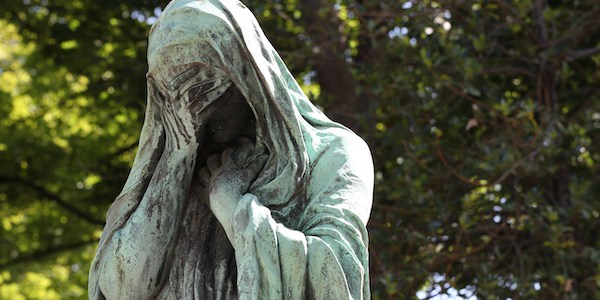
He wept.

I want Joseph to shout and curse them, to throw tables and chairs. But Joseph just turned from them and wept.

This is neither the first nor the last time that Joseph weeps. In fact, throughout the accounting of his life, he has frequent bouts of weeping.[1] At one point, he weeps so loudly that even the Egyptians in the other room can hear him![2] Some have interpreted this weeping as a psychological characteristic of Joseph. He was a tender soul. Passionate and sensitive. That very well may be. But scholars say that’s not the reason for it’s inclusion in Scripture.

Jewish scholar Ariel Seri-Levi notes that there are three main categories for why people weep:

  1. Mourning for the dead
  2. Distress directed towards a leader – it might be, for example, a crying out for justice towards the government or towards the divine
  3. An encounter or reunion between relatives or close friends

Weeping in each of these circumstances communicates something. It shows how a person is in relationship with someone or something.

When Joseph first encounters his brothers begging for food, he doesn’t break down and cry. He is composed and careful about how he will treat them. It isn’t until he hears them discuss what had happened those years ago when they “saw the anguish of his heart when he [had] pleaded” with them.

It is in this moment that Joseph weeps. Going back to Seri-Levi’s categories of weeping – Joseph was not weeping to mourn the dead. Nor was Joseph weeping in distress directed towards a leader. Joseph was weeping because this encounter was not exactly a “reunion” but opened his heart to the possibility that maybe his brothers did actually have a conscience and felt sorrow for what they had done. Seri-Levi says this is one moment for Joseph in a long process of being reunited with his family, and this is why Joseph cries so frequently. For example, when the brothers come back to Egypt and bring Benjamin this time, Joseph once again weeps upon seeing him, but because he is still unwilling to reveal his identity, he does so in secret.

There is much for us to learn in this Genesis reading about the importance of weeping and about the process of healing in our own relationships. But curiously, the church doesn’t pair this reading with a similar gospel reading. It could easily have been Jesus weeping when Lazarus died. No. Instead we get Jesus sending out the 12 apostles.

We get it – Joseph and his brothers are the 12 tribes of Israel in Genesis, and we have the same symbolic 12 in Matthew. That part makes sense.

But perhaps there is something more to reflect on. The story of Joseph and his brothers is a story of love, anguish, violence, wounds, regrets and healing. The same could be said for the 12 apostles. Both sets of 12 were people who were yes leaders, even saints, but who also lived day by day with their own humanity, broken and willful, and in a hostile world.

These are the ones whom God called.

Today, it is you and I who are called. Our messy humanity doesn’t exempt us but rather qualifies us to be sent out to tend to the brokenness in the world. Like Joseph, we may weep frequently. That’s okay. It’s part of healing and moves us ever closer to reunion with others and communion with God. As we go forth in this day, let us remember our own times of weeping – whether in grief, or in protest against injustice, or out of longing for reunion – and talk with God about how this weeping in turn brings the kindom of heaven ever more near.

[1] Ariel Seri-Levi, “Torah Portion of the Week: The Tales Behind the Tears” in Haaretz (December 29, 2016)
[2] Gen 45:2

no word of hope

The Stonewall Inn

Memorial of Saint Boniface, Bishop and Martyr
Lectionary: 353

Tobit 1:3; 2:1a-8
Psalm 112:1b-2, 3b-4, 5-6
Mark 12:1-12

Today’s readings are difficult ones. There’s no easy way to find a word of hope without doing a disservice to the reality of life which while certainly beautiful, is also fragile and broken.

Not all stories have a happy ending, not every cloud a silver lining.

We cannot gloss over the the realities of poverty, racism or the willful destruction of Earth. We cannot give a passing glance to oppression of LGBTQ+ people. In fact this month of June, we remember particularly the Stonewall Riots of June, 28, 1969, when the queer community broke out in spontaneous protests to a police raid targeting their community at the Stonewall Inn in Greenwich Village of New York City.

We humans are no stranger to the harshness of life. Sometimes we are its victims, and sometimes we are its aggressors.

In our readings today we hear from both classic antiquity and the time of Jesus about the  struggle we have to live justly and in right relationship with one another.

In our first reading, Tobit shares with us about his desire to share a meal with “a poor person from among our kin exiled here in Nineveh” only to receive word from his son Tobiah that one from among the poor had been murdered and left lying in the marketplace.

And in the gospel, Jesus shares a parable with the chief priests, scribes, and elders about how a vineyard owner’s servants, and even his own son, were abused and killed out of a sense of disrespect, entitlement and greed. The parable of course is a way for Jesus to point out the hardness of heart that some people had toward Jesus’ message of the radical inclusivity of God’s love.

Far from happy endings, these stories hold only tragedy and heartbreak. There is no dramatic turn of events that saves the day.

“But hope is on the way!” we might cry out in protest. “Jesus does save the day!”

Yes.

But not on that day in Nineveh. Not on June 28, 1969, at the Stonewall Riots, and not on March 13, 2020, when a Black woman, Breonna Taylor, was murdered by police in her Louisville apartment.

That these stories do not end on a hopeful note does not mean that there is no hope. Rather they are an invitation for us to stay present in the moment, in the here and now, tending in a very personal way to one another in the hour of our greatest sorrow and hopelessness. This we must do, even while at the same time we long for and work on behalf of a new creation, “a new heaven and a new earth” (2 Peter 3:13).

Tobit models for us what this might look like. Let’s go back to what happened in Nineveh that day. Upon hearing of the murder of his kin, Tobit says:

I sprang to my feet, leaving the dinner untouched;
and I carried the dead man from the street
and put him in one of the rooms,
so that I might bury him after sunset.
Returning to my own quarters, I washed myself
and ate my food in sorrow….

And I wept.
Then at sunset I went out, dug a grave, and buried him.

Looking at Tobit’s response symbolically, we might ask ourselves:

  • what experiences urge us to “spring to our feet”?
  • what rooms in our home can we open up for others?
  • when are we called to accompany others – or give permission to ourselves – to lament and to weep?
  • what actions are we compelled to take that emerge out of our heartbreak and our deep faith and commitment to God?

Perhaps in the absence of finding a word of hope within these stories, we might instead follow Jesus and become a cornerstone, a foundation of the new heaven and new earth that all of creation longs for.

Image Credit: Rhododendrites, CC BY-SA 4.0 via Wikimedia Commons