where is wisdom?

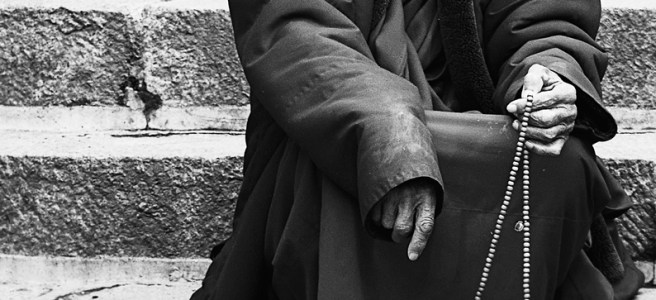
monk holding prayer beads

Wednesday of the Seventh Week in Ordinary Time
Lectionary: 343

Sirach 4:11-19
Psalm 119:165,168,171,172,174,175
Mark 9:38-40

Where is the wisdom we have lost in knowledge?

― T.S. Eliot in The Waste Land and Other Poems

Look around you. Look within you. Gathered in the beautiful and fragile pieces of our lives, Wisdom is here.

  • Wisdom is in the wood and stone of our homes that have stood witness day after day to our joys and sorrows, praises and lamentations.
  • Wisdom is in the books and rosary beads worn smooth from decades of prayer.
  • Wisdom is in our tired bodies that often creak like wooden pews yet persist, nevertheless, in holding the spaciousness that welcomes God.

Wisdom is here.

In the time of the Hebrew Scriptures, wisdom was traditionally associated with rulers. In Proverbs 8:15, for example, it says that it is through Wisdom that “kings reign and princes decree justice”. Leaders such as Solomon were known for their wisdom and for praying that God might help them support and guide the people.

Yet in today’s passage from Sirach, something new is unfolding. The Wisdom about which Sirach speaks goes beyond this traditional understanding of Wisdom. Wisdom is something that not located in one leader or person but is present in all of creation.

Wisdom is here. Wisdom is in you, wisdom is in me, and wisdom is in the “we”.

Jesus echoes this turn in understanding Wisdom when in Mark 9:38-40 John confronts him with the news that non-disciples are healing people in Jesus’ name. Jesus’ response is open and spacious, unthreatened and sure. He affirms the power of God within not only those “officially designated” to act in his name, but all who embrace that deep inner call to follow the path of the Gospel. Like Sirach, Jesus understands that the gifts of God are not for the designated few, but for all.

Wisdom is here.

This Wisdom that we hold, and which holds us, is indeed the greatest of all gifts. Recall how Solomon, who as King could ask for anything and make it happen with all his power and money, asked only for this – Wisdom – not for self-serving rewards like long life or the death of his enemies, but for Wisdom.

My dear sisters and brothers and kin, we live today in deeply troubled times. It seems that Wisdom itself has been fired from its job. It is understandable that in the face of chaos and overwhelm, we respond again and again with the words, “I don’t know”.

“I don’t know what to do”.
“I don’t know how to survive this”.
“I don’t know how to help”.
“I don’t know how to make a difference”.

It feels awful to say, “I don’t know”, yet these three words are not words of resignation, nor of weakness, nor of inaction. No. In fact, these words are powerful beyond measure.

“I don’t know” is the doorway to Wisdom. It is the soul opening up to the more, the depths, the spaciousness within which we must dwell always, but most especially in troubling times.

Wisdom calls us to discern, to see things from God’s perspective. We must trust that what we need to know, what we need to do, will emerge. And as Sirach writes, when we trust Wisdom, wisdom will reveal to us “treasures of knowledge and an understanding of justice.” (Sirach 4:17-18)

Wisdom is here. Wisdom is in you, wisdom is in me, and wisdom is in the “we”.

Remember who you are, and whose you are. Speak the power of the words “I don’t know” and allow yourself to sink deeply into the Wisdom that is breathing within you. Speak the words “I don’t know” again and again and explore that emptiness – “Wisdom’s inmost chambers” as scripture says – within which God reveals Godself. Speak the words “I don’t know” in the solitude of your heart and in the midst of community.

Wisdom is here.

.

image : “Worn Wisdom” by Aaron Greenwood on Unsplash

on humility

I do not know whether I have put this clearly; self-knowledge is of such consequence that I would not have you careless of it, though you may be lifted to heaven in prayer, because while on earth nothing is more needful than humility. Therefore, I repeat, not only a good way, but the best of all ways, is to endeavor to enter first by the room where humility is practiced, which is far better than at once rushing on to the others.

Teresa de Ávila, Interior Castle 1.2.10

I thought I had a good grasp on what humility means. I had understood humility to mean that icky feely when one is embarrassed or ashamed of something that they’ve done. Mortified.

“It’s an opportunity to learn the virtue of humility”, they say. No wonder I’ve always been so resistant to humility.

As it happens, this is not humility at all. It’s humiliation. It’s an understandable misunderstanding. Humiliation and humility share the same etymology. They come from the Latin word humilis meaning “low”.

Humiliation is a sucker punch to the gut. It hurts. It can affect one’s self identity and confidence, and over time, it can can lead to trauma. Humiliation does not make us grow stronger, and it most certainly is not a pathway to the virtue of humility. Don’t ever let anyone tell you different.

Humility is another creature altogether, and I am pleased to make its acquaintance. Teresa de Ávila says that it essential for “while on earth”, and I’m beginning to understand what she means.

I’ve been in Spain now for a couple weeks and also spent some time in Portugal. My castellano – “castilian” is the official language of Spain but there are many languages of Spain including euskara, catalan, and gallego) – is beginner level and my portugués is nearly non-existent. Although english is widely understood throughout the world, it’s not spoken by everyone. I am very conscious of using the local language as a matter of respect and appropriateness. I am a guest and not entitled to others’ deference to my language and the customs of my culture. It is not easy, but I would have it no other way. I’ve had many (MANY) missteps and am grateful for people’s patience. I’ve even had the occasional on-the-spot lesson by generous locals who take the time to help me learn.

I have been realizing that what I really need is to find a space of humility within myself so that I can have more openness to that which is beyond me. A space of humility. Spaciousness. Humility is a kind of pause that recognizes my “me-ness”(self-knowledge) and our “we-ness”. This “we-ness” is about the “more-ness” of any and every experience. I am connected to this people, this patch of earth, this local custom, this typical food, this way of being no matter how much “strange-ness” I or others may feel.

That’s a lot of “-ness” but it’s the best way I can communicate how it feels. “Ness-ness” leaves room for the gracious unknown, the mystery of being, experiencing, and relating. And humility is the doorway to this room, this spaciousness.

It’s a different world when one strives for humility. Living within a different language, culture, and geography for even this short time gives me a concrete and practical example of the humility necessary to be truly open and curious and even surprised. The missteps sting at times, but I am finding my way of being “me” and “we”. I have mastered saying Quisiera un cafe con leche, por favor (“I would like a latte, please”). I am becoming proficient at public transportation by way of metros, buses, tranvías, funiculares, and even a teleférico! These are small things, but they show me a way to enter in, to be part of the larger community and world.

I’m curious to see how humility will continue to unfold in my life – in how I am with myself, in how I perceive things, in relationships, and in pursuit of my passions.

I am also curious to know how you have experienced humility. How have you practiced humility? What does it mean for you?

Image: Photo of three people praying at the
Buddha Tooth Relic Temple, Singapore, by Lily Banse on Unsplash