act by praying … pray by acting

Memorial of Saints Timothy and Titus, Bishops
Lectionary: 520/317

2 Timothy 1:1-8 
Psalm 96:1-10
Mark 3:22-30

Many, many years ago, I was sitting in a high school classroom and delighted to learn that instead of religion class, we’d be watching a movie. Awesome! I thought. No lecture, no class participation, no big deal.

Fifty-six minutes later, my life was changed forever.

The movie was no movie. It was the documentary film Roses in December: The Story of Jean Donovan (1980) and it tells the story of Catholic lay woman Jean Donovan, Maryknoll Sisters Maura Clarke, MM, and Ita Ford, MM, and Ursuline Sister Dorothy Kazel, OSU. These four women were murdered in El Salvador for  working with the poor by government-sanctioned military extremists whose motto was «Haz patria, mata un cura» – “Be a patriot, kill a priest.” And not just priests. Anyone who sided with the poor.

I left that classroom stunned … and with a single question in my heart: for what would I be willing to give my life – and my death?

While today is not the memorial of these 4 Churchwomen (December 2), I can’t help but be reminded of them as we reflect today on two more holy people – Timothy and Titus – who also shaped the life of the Church. We have little time to review their biographies – not because no one likes long homilies – but because we are in a state of crisis. Here and now, we need both the Word and the Table to nourish us as we are called to act by praying and pray by acting.

Timothy, Titus, Jean, Maura, Ita and Dorothy – they stand right alongside the leaders of today who embody the gospel – leaders such as Episcopal Bishop Rob Hirshfeld. In a reflection on January 9 at a vigil for Renee Good in Concord, New Hampshire, Bishop Hirshfeld noted that “the message of Jesus’ love, compassion, and commitment to the poor, the outcast” was comprised when the church became linked to the empire by Constantine in the 4th century. (source)

He says, “And we have lost that voice, and we are now, I believe, entering a time, a new era of martyrdom.” He cites the 4 Churchwomen as well as Oscar Romero who during mass “called upon the death squads of El Salvador to lay down their arms or risk excommunication”. He “was martyred the next Sunday at the altar.”

Hirshfeld goes on:

I have told the clergy of the Episcopal Diocese of New Hampshire that we may be entering into that same witness. And I’ve asked them to get their affairs in order—to make sure they have their wills written, because it may be that now is no longer the time for statements, but for us with our bodies to stand between the powers of this world and the most vulnerable.

And it may mean that we are going to have to act in a new way that we have never seen perhaps in our lifetime, except for these remote stories that I’ve just cited, to put our faith in the God of life, of resurrection, of a love that is stronger than death itself.

For what would I be willing to give my life – and my death?

Our response to this question, and to these witnesses of yesterday and today, will be expressed in a myriad of ways. Some are called to the streets of Minneapolis, Chicago, Portland and perhaps, one day, to our own hometown. Some are called to respond through the spaciousness of their contemplative heart. Some are called to be awake to the pain of broken relationships and broken trust. Some are called to create art and beauty in the face of desperation.  

Stop. Listen. You will hear the call, and you will know how to respond.

Hear these words again from 2 Timothy 1:6-8.

I remind you to stir into flame
the gift of God that you have …
For God did not give us a spirit of cowardice
but rather of power and love and self-control.
So do not be ashamed of your testimony to our Lord …
but bear your share .. for the Gospel
with the strength that comes from God.

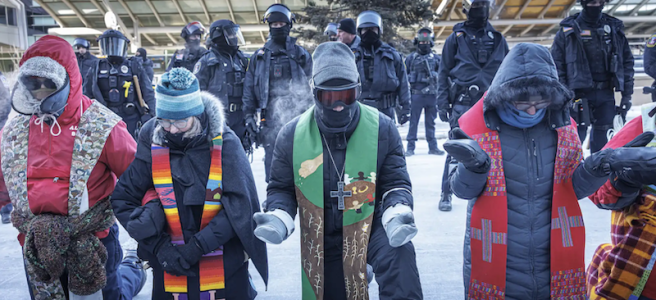
image : Photo by Kerem Yücel | MPR News

“Clergy members and community activists protest Friday in extreme subzero weather at Minneapolis-St. Paul International Airport, calling on Delta Air Lines, Signature Aviation and other companies to stop cooperating with the federal immigration enforcement surge. Police from multiple agencies detained protesters during the action.” (source)

do not give into the weaponization of division

Memorial of Saint Frances Xavier Cabrini, Virgin
Lectionary: 493

Titus 3:1-7
Psalm 23:1-6
Luke 17:11-19

I can’t say that I am particularly enamored of first reading today. The first verse reminding the people “to be under the control of magistrates and authorities, to be obedient” struck a raw nerve with me particularly in light of how much we as a country have wrestled with what kind of leader we want and how we expect our government to serve “we the people”.

The author of the letter to Titus has a thing for keeping the peace in terms of the law and the household. The author, who wrote in the Apostle Paul’s name, insists that everyone play their part and dutifully fulfill their roles and responsibilities. This is not necessarily a bad thing, but it becomes a problem when those roles and responsibilities are shaped by an ideology that grants some people their full human dignity while simultaneously denying it for others.

Though a member of the Christian community, the author of the letter to Titus sometimes reflects more the society around him, than the life of following Jesus the Christ. This particular section of his letter comes on the heels of his exhortations to “older women” that they be

reverent in their behavior, not slanderers, not addicted to drink, teaching what is good so that they may train younger women to love their husbands and children, to be self-controlled, chaste, good homemakers under the control of their husbands, so that the word of God may not be discredited. (Titus 2:3-5)

“Duties for older and younger men are stated, but their duties are not connected to the household: their behavior to their wives and children is not mentioned.” (Joanna Dewey, “Titus” in Women’s Bible Commentary, 604) Similarly, while slaves are exhorted to obey their masters, there is no mention of the responsibilities of the masters in how to treat people who are enslaved. (Titus 2:9-10)

On the one hand, I can’t blame the author of Titus for reaffirming the status quo. Nobody wants mayhem. Nobody wants mass chaos. (The author doesn’t yet see how the status quo is also responsible for dehumanizing women and enslaved persons.)

On the other hand, the author of Titus knows better. He’s the same guy who eloquently calls people to “be peaceable, considerate, exercising all graciousness toward everyone.” And it is Titus who recognizes that we know how to be this way because of the mercy, “kindness and generous love of God”. (3:4-5)

In the new Christian communities, not only women and enslaved persons but lepers, strangers and other “normal candidates” for discrimination are given their full dignity and respect, at least as much as could be expressed at that time and place in history. Christians saw in Jesus the mercy, kindness and generous love of God extended to everyone. They also saw in Jesus one who did not discriminate based on gender, religion, age, politics, or cultural or social norms.

Reading between the lines, we see in the author of Titus a person still very much struggling to work out how everything fits together how to integrate his newfound life in Jesus and his teachings in a world that looked at values, roles and responsibilities, leadership, governance, and human dignity from a very different framework. Further, as a Christian leader, the author of Titus likely felt under pressure to conform to “the control of magistrates and authorities” so as not to cause waves for the newly-established Christian community.

His struggle was real.

And our struggle today is real too.

We live in a nation that is divided, vehemently divided. And some of our “magistrates and authorities” – as well as anyone with a fancy enough soap box – are weaponizing that divide and turning kin against one another.

We’ve got to sidestep this weaponization and not give into making enemies of our own kin, even in the name of the gospel. What do we choose to say, to do about the politics of our time from our rootedness in the mercy, kindness and generous love of God? How do we align ourselves with those who are discriminated against today (which may likely be ourselves) and at the same time reach out peaceably to our kin who would believe differently? How do we know when to angrily overturn the tables or turn the other cheek?

This is a time for deep discernment, my friends, personally and together as a community of faith.

There is work to be done.

As Jesus says to the Samaritan who was made clean from leprosy in today’s Gospel (Luke 17:19)

“Stand up and go;
your faith has saved you.”

.

image : adapted from Santiago Gaughan / The Cougar